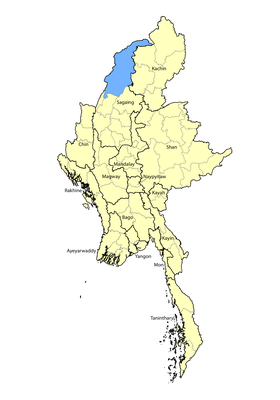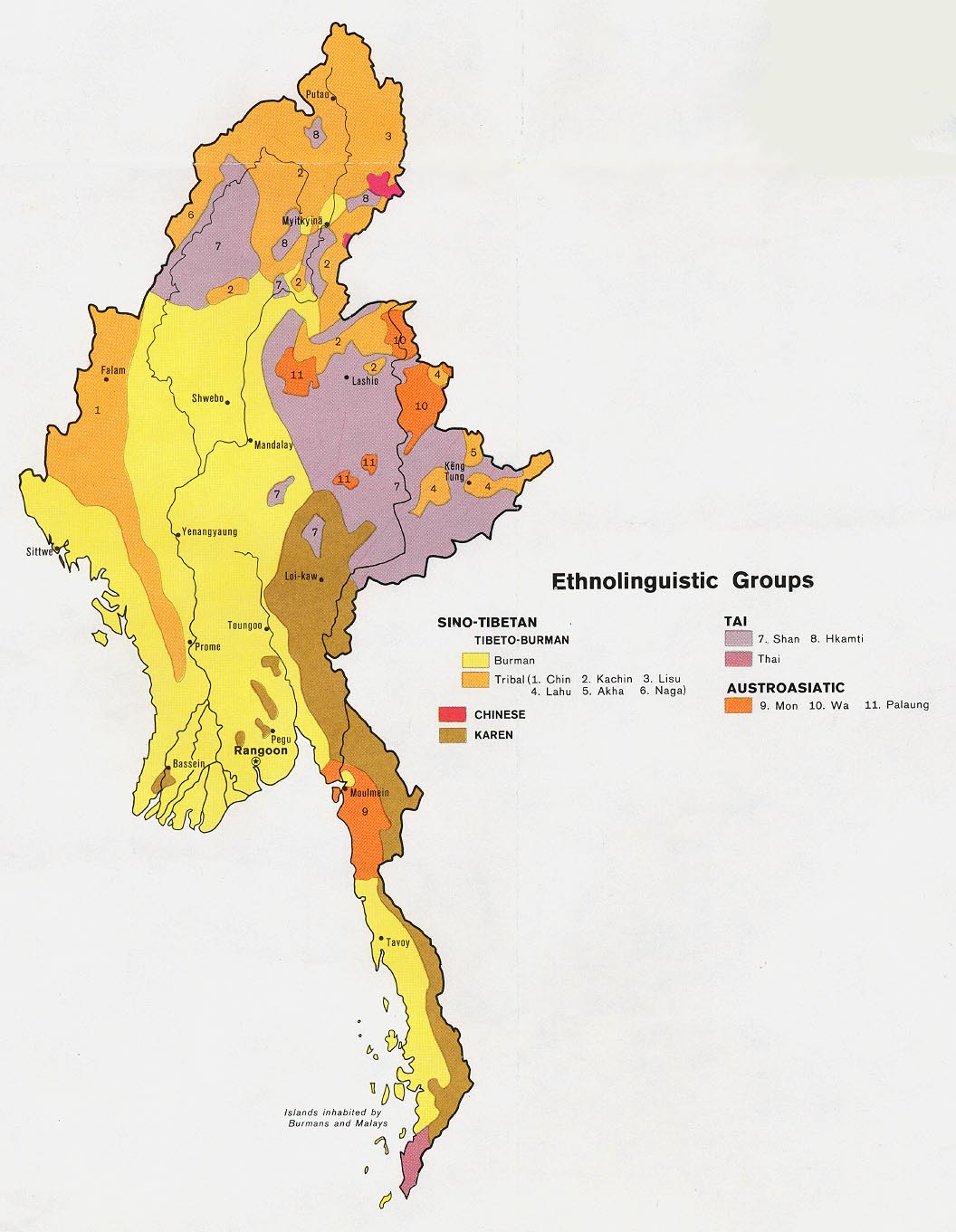

Lungri people live in ethnically mixed villages with many other tribes in the mountainous Lahe and Nanyun townships within the newly-formed Naga Self-Administered Zone, adjacent to the border between western Myanmar and the Indian state of Arunachal Pradesh. The climate there is described as "cool and humid in the hills, but warm and moist in the plains. The area has evergreen rain forests and plenty of animal life." The Lungri are a tribe in transition, with all members of the group who were interviewed in Lahe in 2013 saying they were born elsewhere (especially in Lungri village in Nanyun Township) before beginning to migrate to Lahe in 1990.
The Lungri are one of more than 50 tribes listed under the label of "Tangshang" in Myanmar, but most groups speak their own language or dialect and possess their own sense of ethnic identity and customs. The name Lungri is derived from two words. Lung meaning "stone" or "hill" and ri meaning "water." Thus, it is thought their original homeland was at a place where a stream flowed out of a rocky hill. In recent decades the Lungri have intermarried with other tribes, blurring their distinctiveness as a people. The 600 Lungri people living across the border have been granted status as one of India's Scheduled Tribes under the name Longri Tangsa.
The Lungri were renowned as great warriors who grew wealthy by collecting tribute and taxes from the communities they defeated. Lungri society is divided into clans, which are responsible for different occupations. For example, the Kimkhak and Riawang clans are in charge of performing rituals, while the Lisai and Sisiya were the tribe's blacksmiths, who manufactured items of silver and gold. Wedding ceremonies among the Lungri formerly included some unique customs. To honor newlyweds, "bracelets were woven from hairs from the tails of slaughtered pigs. The couple would wear them on their left wrists as a token of their marriage." Over time, outside influences, including missionary activity and regional political changes, have contributed to shifts in culture and belief systems, though many traditional patterns of life remain intact.
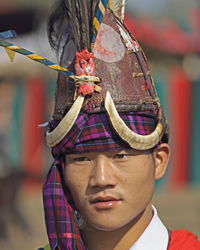
During festivals, Lungri men proudly wear "red bamboo hats decorated in the front with two tusks of a boar. Necklaces, bangles, waistbands, hairpins, silver earrings, beads, coins, and semi-precious stones are also part of their attire."5 The Lungri were traditionally skilled hunters who loved to consume meat, although they were prohibited from eating the flesh of dogs, tigers, langurs, foxes, rats, cats, and tortoises.
The Lungri people typically live in rural, mountainous villages where daily life centers on agriculture and survival in a challenging environment. Farming, hunting, and small-scale local trade form the basis of their economy, with families often cultivating crops on hillside fields. Work is physically demanding, and success depends heavily on seasonal cycles and environmental conditions.
Family life is tightly knit, with extended families often living in close proximity and supporting one another through shared labor and communal responsibilities. Respect for elders and tribal traditions play a strong role in decision-making and social structure. Community life is highly relational, and cooperation is essential for both farming and village well-being.
Cultural life includes festivals, storytelling, and traditional practices that reinforce identity and community bonds. Meals are simple and typically consist of staple grains, vegetables, and locally sourced meat. Because of their remote location, access to modern goods and services can be limited, and many aspects of life remain rooted in long-standing traditions.
Animism dominated the religious beliefs of the Lungri people for countless generations, influencing many of their customs. In the past they believed in "supernatural powers, spirits, and deities. They had a strong faith in malevolent and benevolent spirits, and each village had a thandang (priest) or samma (diviner)." It was believed the ghost of a deceased person would go hungry unless their relatives provided food and drink for it in the afterlife. Prior to their conversion to Christianity starting in the 1970s, the Lungri held a two-day sacrifice called ya bin to pray for good crops. Chickens were sacrificed to the spirits and the people consumed copious amounts of liquor.
Today, the overwhelming majority of Lungri people in Myanmar confess Jesus as Lord, with most being members of Baptist churches, while a few are Catholics. With no Scripture or other Gospel resources available in their heart language, most Lungri believers use Burmese Bibles, which gives them limited understanding.
The Lungri people experience significant challenges related to their remote location, including limited access to healthcare, education, and economic opportunities. Isolation and underdeveloped infrastructure contribute to poverty and restrict access to essential services that could improve quality of life.
Political instability and broader regional tensions in Myanmar add additional uncertainty, affecting safety, mobility, and long-term development. Strengthening local capacity for education, leadership, and sustainable livelihoods would help communities move toward greater resilience.
Spiritually, a deeper understanding of the gospel and consistent discipleship would strengthen believers and help move the community from nominal or surface-level faith to vibrant, Christ-centered living. Encouragement and training can help existing Christians grow into leaders who are equipped to disciple others and participate in God's mission beyond their own villages.
Pray that the Lungri people will experience improved living conditions, including better access to healthcare, education, and reliable food sources.
Ask God to provide stability and peace in their region so that families can live and work without fear.
Pray that local churches will grow in spiritual depth, with believers developing a strong understanding of Scripture and a personal relationship with Jesus Christ.
Intercede for pastors and leaders, that they would be equipped to teach Christ faithfully and shepherd their communities with wisdom and love.
Ask the Lord to raise up workers from within the Lungri community who will carry the gospel to groups that lack a gospel witness.
Pray that the Lungri believers will embrace their role in the global mission of the Church, becoming a source of blessing and witness to others.
Finally, pray that every Lungri individual will encounter the transforming power of Christ, bringing hope, healing, and new life to their families and communities.
Scripture Prayers for the Lungri in Myanmar (Burma).
Asia Harvest
K. S. Singh (ed.), Arunachal Pradesh (People of India, Vol. XIV), (Calcutta: Seagull Books, 1995), p. 340.
2 Graduate Institute of Applied Linguistics, "Fifty-Five Dialects and Growing: Literacy and Comprehension of Vernacular Literature among the Tangshang Naga in Myanmar," (thesis, name withheld, June 2013), p. 16.
3 Naga Survey Team, Sociolinguistic Survey of Makyam and Southern Tangshang Varieties in Lahe Township and Dunghi Sub-Township, Myanmar (unpublished report, 2012), p.xii.
4 J. D. Saul, The Naga of Burma: Their Festivals, Customs, and Way of Life (Bangkok: Orchid Press, 2005), p. 100.
5 Singh (ed.), Arunachal Pradesh, p. 340.
6 Singh (ed.), Arunachal Pradesh, p. 343.
7 Saul, The Naga of Burma, p. 100.
8 Saul, The Naga of Burma, p. 178.
| Profile Source: Joshua Project |
| Other PDF Profile |